How to Set Up an Outdoor Dining Area Your Family Will Actually Use?
The reason most outdoor dining sets go unused isn't the furniture. It's placement. People buy a nice table, put it wherever there's room, and then wonder why nobody eats out there.
Here's the pattern. A dining table in the middle of a yard, with no shade and no reason for anyone to walk past it, becomes decoration. You'll use it twice — the weekend you set it up, and the weekend a guest asks about it. A table near the door, partially shaded, with a clear route from the kitchen, becomes where everyone eats on Saturday morning without thinking about it. Same table. Completely different life.
So the first decision is location, and the questions are simple enough to answer in five minutes. Can you carry a plate there without a relay team? Is there shade for the middle of the day, or a way to add some — an umbrella hole in the table, a nearby tree, an offset canopy? Is it far enough from the grill that a gust of wind doesn't send smoke across the salad? Get those three right and you've done most of the work already. Get them wrong and no amount of quality furniture will save you.
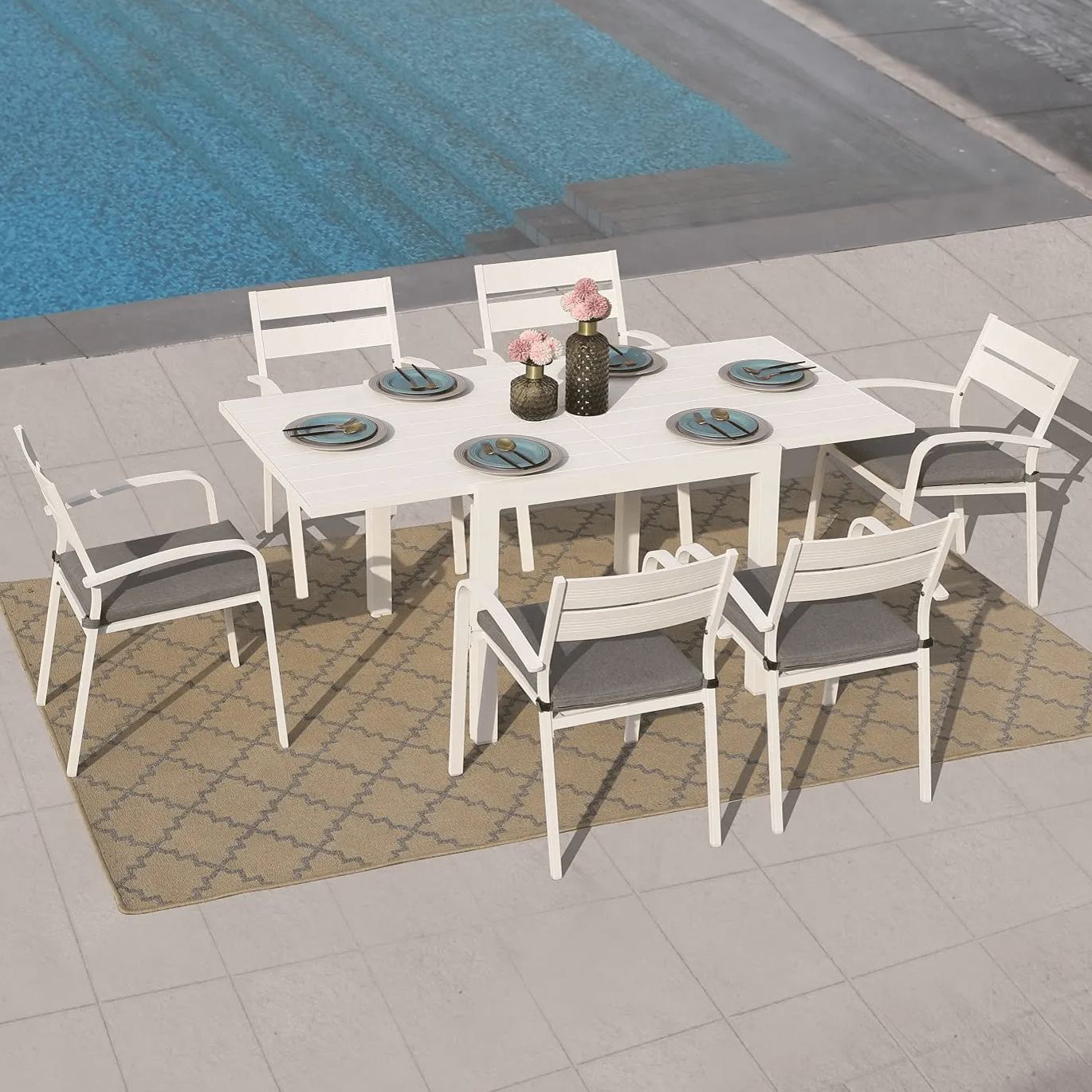
The second decision is size, and this is where people overshoot almost every time. Here's the method: count the people who live in your house. Then count the largest group you realistically host. Buy for the first number, and keep a way to flex to the second. That flex mechanism is an extendable table, and it's the single best decision you can make in this category. It sits at its daily size all year and pulls out when the whole family shows up, which means you're not walking around a furniture warehouse every Tuesday, and you're not turning people away in July.

Rough sizing to keep in the back of your head. A rectangular table around 72 to 84 inches long seats six comfortably; around 96 to 108 inches handles eight. Round tables in the 60 to 72 inch range do similar work with a more sociable shape — everyone can see everyone, which is why round tables tend to host better conversations. Leave about 24 inches of table edge per person, and give yourself 36 inches of clearance all the way around the table so people can push their chairs back and stand up without playing bumper cars with the person behind them. If you're tight on space, that clearance is the first thing to check, not the last.
The third decision, and it's the one that decides whether anyone lingers after the plates are cleared: the chairs. Upright, dining-height chairs with a proper back and arms are the right choice for eating. Stackable chairs with cushions are the right choice for real life, because you can bring six out for a party and stack them away on Tuesday. And if you want to knock out the material question at the same time, wood and aluminum both do this job well — wood if you want warmth, aluminum if you want light weight and a frame that will never rust.
One last thing that's genuinely free. Put something at the table that gives it a reason to exist beyond dinner. A bowl of lemons. A candle that works in the wind. A chessboard that lives there. The tables that get used are the ones that already have lives, not the ones waiting for an occasion.
Comment